
Design Your Next Career Move As a Designer Would

Woman at a desk using a laptop and tablet to design something. Photo by Antoni Shkraba Stuidio, Pexels
I’m coaching a philanthropy leader transitioning to a new role. After more than a decade in a senior position at a foundation, the pivot is kind of a big deal.
Instead of perusing job notices—the typical (dreary) approach -- I suggested we use The New York Times bestseller Designing Your Life: How to Build a Well-Lived Joyful Life, by Bill Burnett and Dave Evans. Years ago, this brilliant little guide helped me shift to what I'm doing – and loving-- now.
Once she began the process, she was sold.
The DYL authors invited her on an inner journey to reflect and define her deepest values and “work vision.” In subsequent exercises, she documented daily activities for a few weeks and assessed the extent to which each felt engaging and energizing.
The next step, mind-mapping exercises, avoided linear thinking to surface out-of-the-box ideas for a new role. She’s currently exploring what her body and spirit tell her are the best three options in her mind maps.
Soon, she’ll create “odyssey plans” to flesh out the possible roles. What’s significant about this approach is that all three roles are not wild fantasies. Each is closely aligned with her work vision, intuition, personality and preferences. The accompanying action plans are grounded in current reality and feasible next steps.
Once she’s drafted her odyssey plans, she’ll check in with herself and me to choose which one she feels called to and capable of pursuing right away. Then there are a few more action steps to advance the plan with full-body, wholehearted commitment. I’ll be alongside her to offer guidance, accountability and reassurance.
The Best Career Planning Guide I’ve Found
In Designing Your Life, Stanford design professors Evans and Burnett apply design thinking -- a methodology created by industrial designers 50 years ago (see sidebar) -- to career change. The book is a distillation of their work with dozens of people, each with impressive results.
The step by step process is interspersed with relatable stories of real people working through doubts, blocks, setbacks and, ultimately, finding meaningful careers.
I loved the chapter “Failure Immunity” that reminds us that failures are the building blocks of success. I described the authors’ 3-step process to turn setbacks into lessons learned in an earlier post, “Reframe Failure and Grow Your Grit.”
Reach out for a free Zoom if you’d like support and accountability as you explore values-aligned options for your next career move.
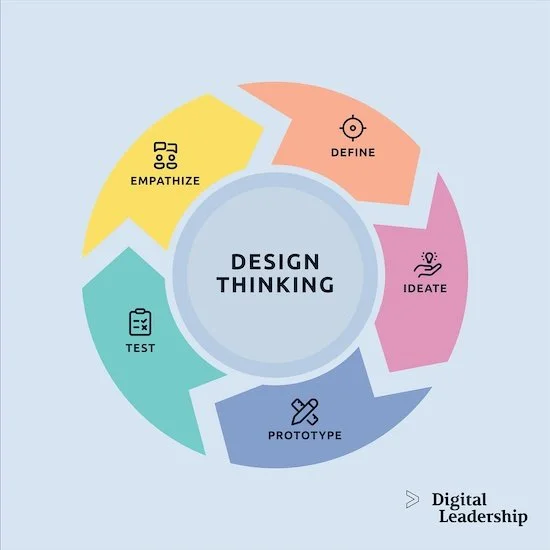
The phases in the DT model are sequential and flow in a circular fashion, to be repeated as often as needed. Image: Digital Leadership
Design Thinking 101
For those unfamiliar with design thinking or DT, it’s an approach Stanford product engineers pioneered in industrial design in the 1950s and ‘60s. Most famously, the approach led to the creation of the computer mouse. It’s since been used in every kind of business setting and now in the career planning context.
The DT process starts with a close examination of the end-user’s actual experience, viewing a challenge from their point of view and taking into account their circumstances and needs. Significantly, the model labels this Step 1 “Empathize.”
The design-thinking framework involves six phases:
1. Empathize
2. Define
3. Ideate
4. Prototype
5. Test
6. Implement
For more on the DT framework, see this site.